Army West Point Athletics
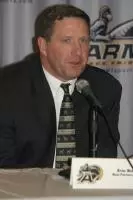
Stan Brock Names Football Coaching Staff
March 01, 2007 | Football
WEST POINT, N.Y. Army head football coach Stan Brock filled his coaching staff today when he named 12 members to the group. Nine holdovers from the Black Knights’ coaching staff this past season are included on the list, including defensive coordinator John Mumford.
In addition to holdovers Mumford, Wally Ake (cornerbacks), Dan Baranik (wide receivers, recruiting coordinator), Tyree Foreman (offensive assistant), Justin Hardin (defensive assistant), Clarence Holmes (defensive line), Gary Miller (special teams), John Misciagna (tight ends) and Adam Waugh (safeties), Brock named three new coaches to his initial West Point coaching staff on Thursday.
One of those three new coaches named by Brock is an individual familiar to Army followers as Tucker Waugh returns to coach the Black Knights’ running backs following a two-year absence along the banks of the Hudson. Former National Football League standouts Robert Lyles and John Tice are the other new members named to Brock’s initial staff at the Academy, tabbed to mentor the Black Knights’ linebackers and offensive line, respectively.
The group joins former Portland State University head coach Tim Walsh, who was named Army’s offensive coordinator and quarterbacks coach last month.
An assistant coach at Army from 2000 through 2004, Waugh spent the previous two years guiding wide receivers at Stanford University. He held the same role during his first tenure at West Point, doubling as the Black Knights’ recruiting coordinator during his final two seasons. A member of Bobby Ross’ original Army coaching staff, Waugh departed the Academy to work with head coach Walt Harris at Stanford in January 2005, continuing to build a reputation as a bright, energetic, intelligent, young coach. A year ago, he worked with Richard Sherman, who was named to The Sporting News’ Pac-10 Conference All-Freshman team.
When Waugh first arrived at Army, he inherited a group of receivers who had caught a combined total of 14 career passes. Over the next three years, his Black Knight wideouts registered 322 receptions. During that time, he oversaw the development of Aaron Alexander, who graduated in 2005 and ranks second on Army’s career charts for receptions and receiving yards.
Prior to arriving at West Point, Waugh coached for five seasons at Illinois State University (1995-99). He worked with the Redbirds’ outside linebackers in 1995, running backs in 1996 and wide receivers his final three years. He mentored an All-Gateway Conference selection during each of his three seasons as receivers coach, with Marquis Mosely earning recognition in 1997 and Ricky Garrett copping laurels in both 1998 and 1999. Waugh helped to establish the Redbirds’ passing attack as one of the most prolific in the nation. They went to the NCAA Division I-AA playoffs in 1998 and advanced to the Division I-AA national semifinals in 1999.
A 1993 graduate of DePauw University, where he earned a bachelor’s degree in English composition and physical education, Waugh began his coaching career at Otterbein College in 1993 overseeing the Cardinals’ quarterbacks. He returned to his alma mater in 1994 as a wide receivers coach. He also completed a coaching fellowship with the British Columbia Lions of the Canadian Football League.
Waugh lettered at quarterback while playing at DePauw from 1990 to 1992 and was named the school’s Outstanding Physical Education major. After coaching wide receivers for the past nine years at Illinois State, Army and Stanford, he will focus his efforts on the Black Knights’ running backs during his second stint at the Academy.
“I’m very excited to have Tucker come back to West Point,” states Brock. “As an offensive line coach at Army, I watched him coach the receivers and he had that group of players believing that it was just as important to get inside and block linebackers as it was for them to catch touchdown passes. Anyone who could convince wide receivers to do that, I knew I wanted him on my staff.”
Lyles, a former standout linebacker at Texas Christian University, played eight seasons in the National Football League, serving tenures with both the Houston Oilers (1984-89) and Atlanta Falcons (1990-91).
Following his departure from the Falcons, Lyles continued his playing career in the Arena Football League, spending a year with both the Tampa Bay Storm (1994) and Memphis Pharaohs (1995).
Lyles first crossed paths with Brock when the duo was paired against each other in the National Football League. Always impressed with Lyles’ tenacity and knowledge of the game, Brock went on to name Lyles his defensive coordinator during both of Brock’s head coaching stints in the Arena Football League.
Lyles began his coaching career in 1999, serving as Brock’s defensive coordinator for the Portland Forest Dragons. He went on to fill the same role for Brock with the Los Angeles Avengers one year later.
The defensive-minded Lyles was named the Avengers interim head coach four games into the 2001 season and guided the club to a 5-6 record the remainder of the year. Under Lyles, the Avengers ranked first in the AFL in total defense (allowing an average of 249.4 yards per game) in 2001 and second in passing defense (231.5 yards). Los Angeles was also listed first in scoring defense (39.3).
He was chosen as head coach of the Georgia Force the following season and shouldered those duties for the first five games of the 2002 campaign.
In addition to his coaching experience in the Arena League, Lyles has spent six seasons working in NFL training camps under the NFL's Minority Coach Fellowship Program. Current NFL head coaches Herman Edwards and Marvin Lewis have also taken part in the program. He served as an assistant coach at San Bernadino Valley College in 2004.
“I played against Robert in the National Football League and was fortunate enough to have him as my defensive coordinator, both in Portland and in Los Angeles, where his defense led the Arena Football League,” explains Brock. “That league is not built for defense, so I was always impressed with how he motivated and was able to teach players different techniques. Robert will bring a lot of energy and excitement to our program. His personality is going to carry over to the cadets. Because he played linebacker for all those years in the National Football League, he’s going to bring instant credibility to the players. They’re going to understand what he’s going to try to teach them.”
Brock added a former teammate to his first Army coaching staff with the addition of Tice. The duo first became acquainted sharing roster spots with the New Orleans Saints from 1983 through 1992. A 10-year NFL veteran, Tice was a third-round choice of the Saints in the 1983 NFL Draft. He played in 134 games at tight end during his professional career and drew 56 career starts.
Tice retired in 1992 due to a shoulder injury. At that time, he ranked ninth on the Saints’ career receptions list (158) and 11th in games played (134). He closed his professional career with 1,602 receiving yards and 15 touchdown receptions.
At the conclusion of his playing days, the Bayshore, N.Y., native entered the private business sector and served as a volunteer football coach for several high schools in the state of Florida. He joined the coaching staff of the Minnesota Vikings in 1999 as an offensive assistant before adding duties as the club’s tight end coach in 2000. In all, he spent seven years on the Vikings’ coaching staff.
The 1983 graduate of the University of Maryland earned honorable mention All-America honors as a senior. He ranked as
the Terrapins’ leading receiver during each of his final two seasons.
“I’m really excited about having John Tice serve as our offensive line coach,” Brock says. “It was a very difficult decision. I had some tough choices to make. We had four really good candidates for the position. But I feel he will be the best fit with my personality and the personality of West Point. He was my teammate for 10 years in New Orleans, so I know how John handles the good times and the bad.
“He was a tight end in the NFL, but he coached the offensive line with the Minnesota Vikings, and he knows a lot of football.”
One of Brock’s chief goals in developing his staff was to keep as much continuity within the Army program as possible. With nine holdovers from last year’s staff, he feels he has accomplished that mission.
“One thing that was important was that we keep things as close as possible,” Brock adds. “This is not a full coaching staff change with a change in philosophy. What this is just making a couple of minor moves and bringing in the people that I was very interested in bringing in. The guys that are here are the ones that I want to be here. I’m very excited that coach Mumford decided to stay. I think the foremost important areas are obviously your offensive and defensive coordinator, offensive line coach and secondary coach. Keeping those intact on defensive side is important because we are making some changes on the offensive side of the ball.”
Army will begin spring practice on Tue., March 20. The 15-day sessoin will conclude on Sat., April 14 with the annuall Black/Gold game at Michie Stadium.
2007 Army Football Coaching Staff
John Mumford, Defensive Coordinator
Tim Walsh, Offensive Coordinator; Quarterbacks
Wally Ake, Cornerbacks
Dan Baranik, Wide Receivers; Recruiting Coordinator
Tyree Foreman, Offensive Assistant
Justin Hardin, Defensive Assistant
Clarence Holmes, Defensive Line
Robert Lyles, Linebackers
Gary Miller, Special Teams
John Misciagna, Tight Ends
John Tice, Offensive Line
Adam Waugh, Safeties
Tucker Waugh, Running Backs